Lutein, zeaxanthin and bilberry: what eye supplements can and can’t do
“Eye vision capsules” are sold with promises of sharper sight and protection from screens. One of the largest eye-nutrition studies ever run gives a clear picture of what such supplements can do — and for whom.
Reviews in “Eye care”
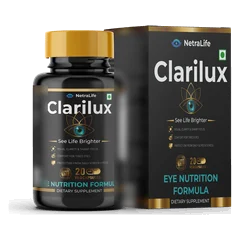 Clarilux capsule
Listed in rotating order, not ranked. We do not rate or rank products.
What the big trials showed
The US National Eye Institute ran two large trials, AREDS and AREDS2. A high-dose formula of vitamins C and E, zinc, copper, lutein (10 mg) and zeaxanthin (2 mg) slowed progression to advanced age-related macular degeneration (AMD) in people who already had intermediate or advanced AMD.
- It did not prevent AMD in people who did not have it.
- It did not help people with early AMD.
- It had no effect on cataract.
So an eye supplement makes sense for a specific group, after an eye doctor finds AMD — not as a general “vision booster”.
Lutein and zeaxanthin
These yellow pigments collect in the centre of the retina. Green leafy vegetables (palak, methi leaves), corn and egg yolk are good food sources. Supplements with lower doses or without the other AREDS2 ingredients have not been tested in the same way.
Bilberry
A berry related to blueberry, famous for a wartime story about pilots’ night vision. Well-designed studies found no improvement in night vision in healthy people, and the US National Center for Complementary and Integrative Health says it has not been clearly shown to help any condition. It may add to blood thinners.
Screen strain: what actually helps
- Every 20 minutes, look at something 20 feet away for 20 seconds.
- Blink fully; use lubricating drops if your eyes feel dry.
- Get your glasses checked — uncorrected vision is a common cause of strain.
- Keep the screen at arm’s length and slightly below eye level.
Emergencies no capsule can wait for
Sudden vision loss, flashes of light, a shower of floaters, a “curtain” over vision, or a painful red eye with blurred sight — go to an eye hospital the same day. Glaucoma and cataract are treated with drops, laser or surgery; supplements do not replace them.
Independent sources: NEI — AREDS/AREDS2 questions and answers · NCCIH — Bilberry